Henri's berichten over zijn recente activiteiten

Henri's reports on his recent activities

Posts tonen met het label jellyfish. Alle posts tonen

zondag 30 december 2012

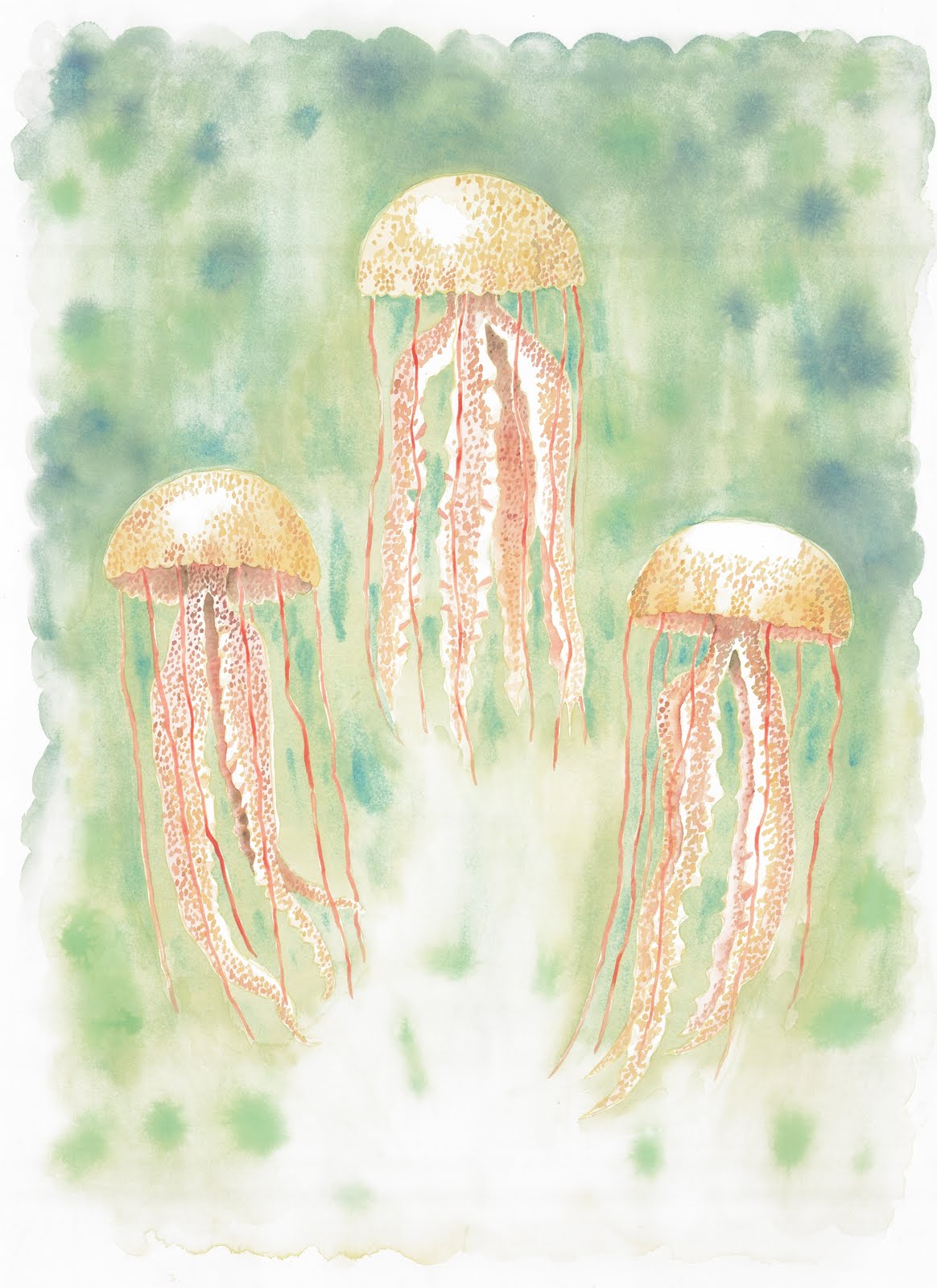
Polyclonia frondosa


Polyclonia frondosa   (B 237),  2012. Wash of  Indian Ink
(38 x 27 cm)


De winterdag met weinig helder licht is geschikt voor grafisch werk. 
Hierbij  een studie in gewassen Oost-Indische inkt.

Winter, when bright light is scarce, is the time to take up graphical work.
Herewith a study in a wash of Indian Ink

donderdag 2 augustus 2012

Swarm of Rhizostoma Jellyfish

One more swarm of jellyfish - now it is the Barrel Jellyfish (Rhizostoma) 
Rhizostoma Jellyfish Swarm, watercolour, 2012  (ca. 30 x 20 cm)   

zondag 16 oktober 2011

Sunfish / Maanvis

Sunfish / maanvis - watercolour 2011 (c. 70 x 50 cm)


Several jellyfish species are preyed upon by Sunfish (by the way, in Dutch it is called "Moonfish").
This is how I imagine such a raid.

dinsdag 2 augustus 2011

XIX: Black / Zwart


Physalia pelagica, Indian Ink, c 30 x 40 cm (2011)
Ik herinner me de door Gustave Doré geïllustreerde Bijbel, en de platen in de boeken door Jules Verne. Als kind joegen de plaatjes in Alice in Wonderland (getekend door John Tenniel) me zelfs angst aan. Mijn fascinatie voor de negentiende eeuw betreft zeker ook deze “zwarte” illustraties. Dit is de aanleiding voor het “zwarte” beeld van het Portugese Oorlogsschip.

I remember the bible with the Doré illustrations, and the plates in the books by Jules Verne. As a child, the pictures in Alice in Wonderland (drawn by John Tenniel), even frightened me. My fascination for the 19th century certainly also includes these “black” illustrations. This triggered the “black” image of the Portuguese man-of-war. 

vrijdag 20 mei 2011

2nd of 3 graces

The Purple-striped jelly or Mauve Stinger  (Pelagia noctiluca) is portrayed twice; once in watercolour and once in spraypaint/stencil. It is one of the three jellyfish species, that were a popular Blaschka glass model.The previous blog-entry shows Rhizostoma pulmo.


Pelagia noctiluca spraypaint/stencil, 2011
(c 30 x 20 cm)
Pelagia noctiluca watercolour, 2010
(c 70 x 50 cm)
Hierbij twee uitbeeldingen van de Parelkwal of Lichtende kwal (Pelagia noctiluca); eenmaal in aquarel en eenmaal in sjabloondruk (spuitbus). Het is een van de drie kwallensoorten die als glasmodel gemaakt door Blaschka gewild waren. Het vorige blogbericht toont Rhizostoma pulmo

woensdag 13 april 2011

Klasse, Orndung, Art: 200 Jahre Museum für Naturkunde

Die Jubiläumsausstellung des Museums für Naturkunde zu Berlin (Humboldt Universität) wird gefeiert mit der Ausstellung “Klasse, Orndung, Art”. Diese ist bis zum Ostern 2011 verlängert worden. Das wundevoll illustrierte Begleitbuch sowie die Ausstellung präsentierten die Glasmodelle von Blaschka recht glorios.
Ich skizziere / Me, sketching  (6/4/2011)


sketches in  pencil (2011)
Class, Order, Species
The bicentenary of the Museum für Naturkunde (Berlin, Humboldt University) is celebrated with the exhibition “Klasse, Ordnung, Art”. The show is extended until Easter 2011. In the accompanying beautifully illustrated publication as well as in the exhibition itself, the Blaschka glass models are presented gloriously.

woensdag 30 maart 2011

Academic nostalgia. And an illustration too

indian ink and a wash of gouache, 2011, (c 30x20 cm)

This entry is an evocation of the oceans and thus it is in illustration style.
Nostalgia made me do two academic studies: one in charcoal, the other in diluted Indian ink, highlights in white acrylic primer on wrapping paper (both c. 30 x 20 cm) .


Hierbij een evocatie van de oceanen, en de stijl is illustratief.
Uit nostaglie komende  twee andere studies voort: een in houtskool, de andere in verdunde O-I inkt, gehoogd met witte acrylprimer op pakpapier (beide c. 30 x 20 cm).

dinsdag 22 maart 2011

Cartoon Style


Study of jellyfish, indian ink on paper 2011 (20 x 30 cm)
 This entry is a study on the cartoonist’s way. As a bonus: a jelly fish study in a wash of ink on wrapping paper


Study of jellyfish, wash of indian ink on wrapping paper 2011 (20 x 30 cm)
 Dit keer een studie op de manier van de cartoonist. Als bonus: een kwalstudie in gewassen inkt op pakpapier.

dinsdag 8 maart 2011

Comix Style


Black and white studies of jellyfish (B238) in comic style,
Indian ink and poster colour, 2011 (c20x30 cm)
This time a design in comic style, a modest tribute to Robert Crumb and his psychedelic works.

Dit keer een ontwerp in comicstijl, een bescheiden saluut aan Robert Crumb en zijn psychedelische werk.

Dieses Mal eine Gestaltung in Comicstil, eine bescheidene Hommage an Robert Crumb und sein psychodelisches Werk.

dinsdag 1 maart 2011

More Style Exercises

Een vervolg in stijloefeningen. Een kwal als mode-impressie en als technisch voorwerp.
Style exercises continued. A jellyfish as fashion image ans as a technical object.
postercolour, c 20 x 30 cm

Indinan Ink, c 20 x 30 cm

woensdag 23 februari 2011

Style attempts

De winterdag met weinig helder licht is geschikt voor grafisch werk. Hierbij stijloefeningen in zwart-wit.

Winter, when bright light is scarce, is the time to take up graphical work. Herewith style attempts in black and white.


Black and white studies of jellyfish (B238), Indian ink and poster colour, 2011  (each c 20x30 cm)

maandag 3 januari 2011

2011

Also in the next year, 2011, I will respond visually to the legacy of Leopold Blaschka and his son Rudolf, the Dresden glass workers.
This activity is added to editing my manuscript “Leopold and Rudolf Blaschka : formation and development of the glass model makers.”

Ook het komende jaar, 2011, zal ik beeldend reageren op de nalatenschap van Leopold Blaschka en zijn zoon Rudolf, de glasvormers uit Dresden.
Deze activiteit staat naast het bewerken van mijn manuscript “Leopold and Rudolf Blaschka : formation and development of the glass model makers.”
"Father, son, Crambessa tagi". Mixed media (watercolour and spraypaint), 2010 (30x40 cm)


The jellyfish species Crambessa tagi was first described by the German zoologist Ernst Haeckel 
(see blogs 26/11/109 and  2/12/2010)

donderdag 23 december 2010

Light in the darkness

Naar aanleiding van het seizoen is het onderwerp “licht in het donker” gekozen: Een heldere figuur tegen een donkere achtergrond. Het is tegelijkertijd een studie van de kwal Aequorea cyanea, een lichtgevende (bioluminescerende) soort.

Aequorea cyanea, study in watercolour, 2010 (16 x 20 cm)

Induced by the season, the theme “light in the darkness” is chosen: A bright figure against a dark background. Which is simultaneously a study of the jellyfish Aequorea cyanea, a light-emitting (bioluminescent) species.