Henri's berichten over zijn recente activiteiten

Henri's reports on his recent activities

woensdag 7 maart 2012

Orgelpijpkoraal / Organ Pipe Coral I


Tubipora musica, watercolour, 2012 (c.  26,5 x 18 cm)
De buisjes van het skelet van  het orgelpijpkoraal lijken, als groep, op orgelpijpen. De natuur heeft hiervoor een partituur geschreven.


The tubes of the skelton of the Organ pipe coral  resemble, as a group, organ pipes.  Nature wrote a music score for this.

zondag 26 februari 2012

For couch potatoes

De bank in de woning: een meubel, en ook een blikvanger in het interieur: het verschaft je stijl, klasse, design, smaak. Mag een bank alstublieft ook een plek zijn waarop je kunt liggen dromen? 
Denk aan de sofa van Freud, met het Perzische tapijt eroverheen. Dat is een nest, een veilige plek om je terug te trekken. Gooi een tapijt over je bank en lanceer een mode. 
Couch, watercolour, 2012  (c. 18 x 25 cm)
The couch at home: furniture, and an eye catcher in the interior as well: it brings you style, class, design, taste.  Can a couch be a place to lie down and dream, please? 
Remember Freud’s couch , covered with a Persian rug. This is a nest, a safe place to retire. Throw a rug over your couch and launch a  fashion.

dinsdag 21 februari 2012

Naturalia in Naturalis

Naturalis in Leiden presenteert een tijdelijke opstelling onder de titel “Naturalia”. Stukken uit het gesloten Zoölogisch Museum van de universiteit van Amsterdam hebben een nieuw tehuis gevonden en worden nu getoond voordat ze niet zichtbaar voor het publiek bewaard worden in de depots. De entree met onder meer composities van schelpen, tropische vogels is indrukwekkend.
Echter, halverwege de tentoonstelling verschuift de focus van “verzameling” naar ”het verzamelen”, of preciezer: “het wetenschappelijk verzamelen op expedities”. Dus eigenlijk zijn het twee tentoonstellingen onder één noemer.
Het verzamelen, ingegeven door het bijzondere, het interessante, en de visueel aantrekkelijke eigenschappen van de objecten uit de natuur komt echter tot op heden voor. De verzameling “Monsters” die Sea Life in Scheveningen op dit moment bijvoorbeeld laat zien illustreert die belangstelling. Een van de getoonde monsters is daar een spinkrab, een soort die ook bijna steevast terug te vinden is tussen “naturalia”.
De verschuiving naar “wetenschappelijk verzamelen” suggereert een blinde vlek voor de esthetische en culturele aspecten van naturalia-verzamelingen. Een bijna religieuze preoccupatie met wetenschap an sich is te vermoeden.

(Ik bezocht de tentoonstelling op 10 -2 -2012)

The Dutch Natural History Museum “Naturalis” in Leyden presents a special exhibition titled "Naturalia" (natural history objects) from the now closed Zoological museum of Amsterdam University found a new home end they are put on show before they will be invisible for the visitors in the storerooms.
The entrance encompassing among other things compositions of shells and tropical birds is impressive.
However, midway the exhibition the focus shifts from “collection” to “collecting”, or even more precisely: “scientific collecting at exhibitions”. In fact, there are two exhibitions under one heading.
Collecting, inspired by the extraordinary, the interesting and the visual attractive features of natural objects is alive until today. For instance, Sea Life in Scheveningen shows a collection of  “Monsters” that illustrates this orientation. One of the monsters that there is on show is a Spider Crab, an organism that is also almost invariably present among “naturalia”.The shift to “scientific collecting” suggests a blind spot for the aesthetic and cultural dimensions of naturalia collections. An almost religious preoccupation with science as such may be sensed.

( 10-2-2012, I visited this exhibition)

vrijdag 17 februari 2012

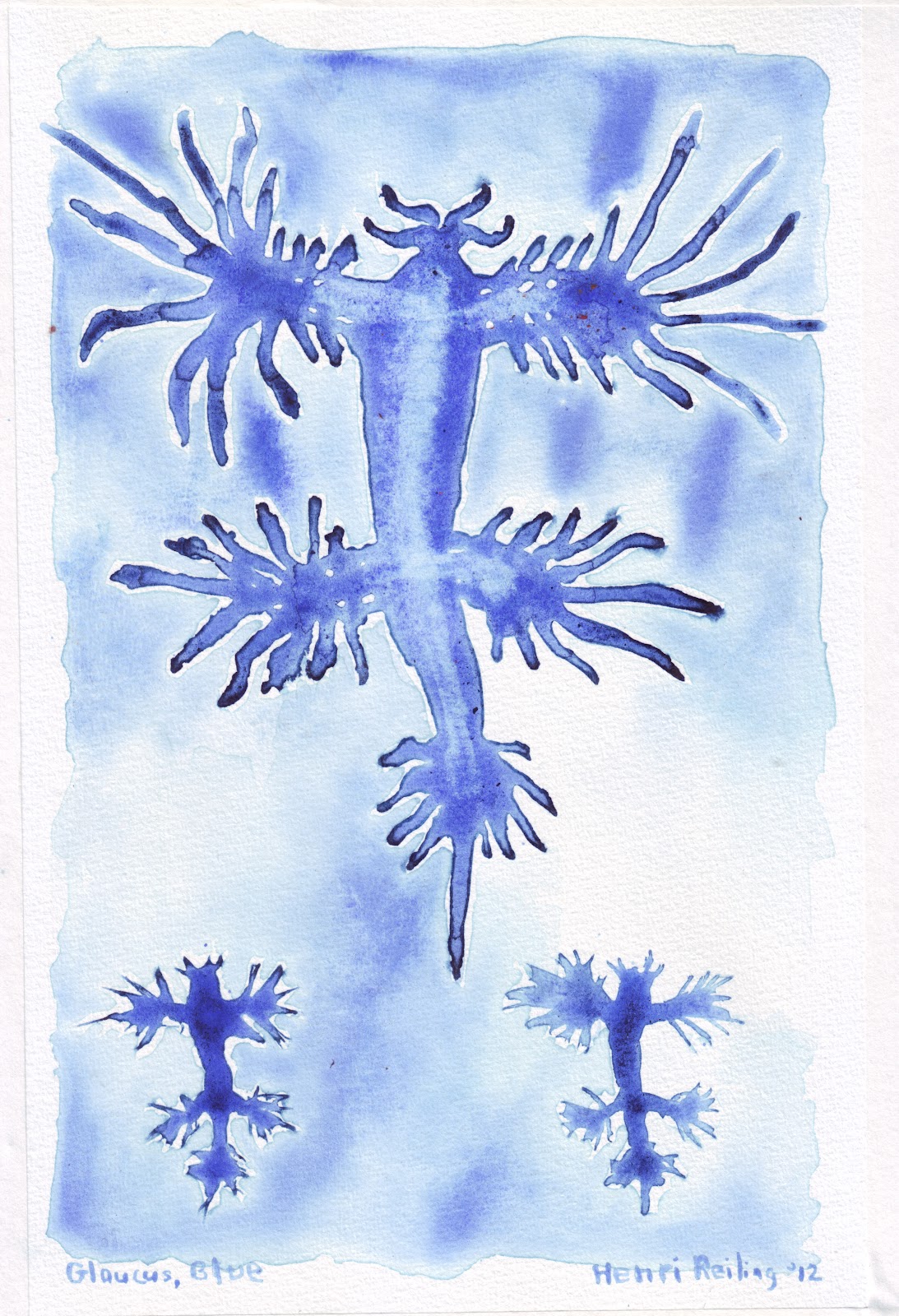
Glaucus, Blue

Glaucus Blue, watercolour, 2012  (ca 27 x 18,5 cm) 

In de Griekse mythologie is Glaucus een visser die in een zeegod veranderde na het eten van magische kruiden. In de dierenwereld is Glaucus een zeenaaktslak die ik waardeer om zijn decoratieve eigenschappen.

In Greek mythology, Glaucus was a fisherman who transformed into a sea deity after eating magical herbs. In the animal kingdom, Glaucus is a sea slug that I value because of its decorative features.


dinsdag 7 februari 2012

Swarm of Moon Jellyfish

Moon jellyfish Swarm, watercolour, 2012
(ca. 26 x 19 cm)  
Increasing jellyfish numbers  around the world may  be due to changes in the sea environment, caused by global warming. Even so, abundance of life in a moon jellyfish bloom is a beauty.

dinsdag 31 januari 2012

Strobilation

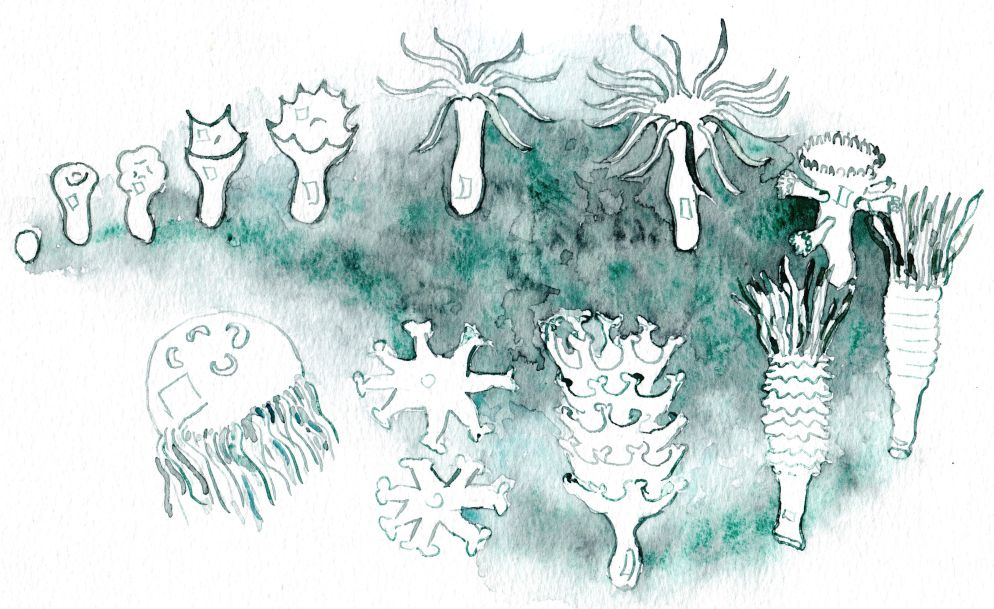
The moon jellyfish (Aurelia aurita) reproduces both sexually, and asexually  in a process indicated as strobilation. This process occurs during the colonial polyp stage and produces either polyps or juvenile medusae called ephyra. Strobilation tend to occur at specific periods, typically early spring.
Aurelia aurita - Strobilation. Diluted Indian ink,  2012 (30 x 20 cm) 
The reproduced drawing has no claim to scientific accuracy, but it  draws attention to the abundance with which the moon jelly releases is reproductive organisms.

maandag 23 januari 2012

Nature = Abundance

Aurelia aurita - abundance. Diluted Indian ink,  2012 (20 x 20 cm) 


The life cycle of the common jellyfish (Aurelia aurita) is usually pictured as a series of separate stages. We could give it a thought that in nature, these individual stages may manifest themselves in huge numbers. I feel that abundance is the mark of nature. Like stars in a clear night, the uncountable amount is stunning and awe inspiring. 

Aurelia aurita  Entwicklung (B225) I  (11 x 15 cm)


Aurelia aurita , Entwicklung (B225) II, 2008 (16 x 25 cm)

De levenscyclus van de oorkwal (Aurelia aurita) wordt meestal weergegeven in een reeks afzonderlijke stadia. We zouden mogen bedenken, dat in de natuur deze individuele stadia in enorme aantallen voorkomen. In mijn beleving is overvloed het kenmerk van natuur. Zoals bij sterren op een heldere nacht, zijn de ontelbare aantallen verbluffend en ontzagwekkend.